Image

The Macon-Bibb County Fire Department enjoyed the beautiful Spring weather during the International Cherry Blossom Festival's Bed Race (Photographer Nate Weeks)



The first full week of Spring will have plenty of hot temperatures, as well as a few chances of showers, if the National Weather Service's forecast is accurate. No temperatures should fall below zero this week, but temperatures will fall somewhat during the weekend. Astronomically, Regulus will draw close to the Moon this Sunday. The following is the day-by-day weather forecast for this week in the heart of Georgia.
DAY-BY-DAY WEATHER FORECAST
MONDAY, March 23rd
Mostly sunny with a high temperature near 85. West wind 5 to 10 mph, with wind gusts as high as 20 mph.
Monday Night
Partly cloudy skies, and a low temperature of around 55. Northwest wind 5 mph, with gusts as high as 20 mph.
TUESDAY, March 24th
Partly sunny skies with a high temperature near 64. East wind around 10 mph, with gusts as high as 20 mph.
Tuesday Night
30% chance of showers, mainly after 2 a.m. Mostly cloudy skies, with a low temperature around 51.
WEDNESDAY, March 25th
30% chance of showers before 8 a.m. Mostly cloudy skies with a high temperature near 69.
Wednesday Night
Partly cloudy skies with a low temperature around 53.
THURSDAY, March 26th
Mostly sunny skies with a high temperature near 82.
Thursday Night
Mostly clear skies with a low temperature around 60.
FRIDAY, March 27th
Mostly clear skies with a high temperature near 88.
Friday Night
Mostly clear skies, with a low temperature of around 56.
SATURDAY, March 28th
Sunny skies with a high temperature near 72.
Saturday Night
Partly cloudy with a low temperature around 43.
SUNDAY, March 29th
A mix of clouds and sunshine with a high temperature of around 70. Winds ENE at 5 to 10 mph.
Sunday Night
Generally clear skies with a low temperature of around 46.
ASTRONOMY IN MIDDLE GEORGIA
This Friday, March 26th, the First Quarter Moon will come close to Jupiter, which can be observed with or without binoculars or telescopes. Jupiter has at least 101 moons that orbit around it, with the largest moons being Io, Europa, Ganymede, and Callisto. Then, on Sunday, March 28th, the Moon will pass closely by Regulus, a blue-white star. Regulus is also known as Alpha Leonis. It is the brightest star in the constellation Leo as well as one of the brightest stars in the night sky. Regulus' nickname is Little King. The star is associated with royalty and power in many cultures: the ancient Persians knew it as one of the Four Royal Stars, which stood for leadership and fortune, while Greek mythology tied the star to the Nemean Lion, which represented strength and courage. Regulus should also be observable with or without binoculars or telescopes, even though it is approximately 79 light years from our solar system.
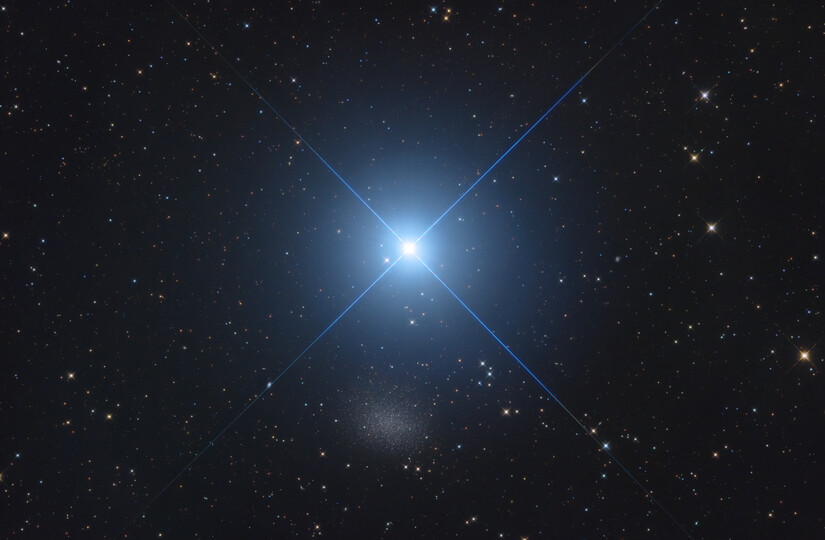 Regulus and the Dwarf Galaxy (Photograph courtesy of Markus Horn)


Light rain shower, with a high of 78 and low of 64 degrees. Light rain shower during the morning,