Image

The sun should be shining bright several days this week (Photographer Nate Weeks)



Middle Georgia should get a bit of rain to start the week after Tuesday, but the rest of the week should be sunny enough to get outside and finally cut the grass, if the National Weather Service's weather forecast proves accurate. Skywatchers can get a good view of Venus and Pollux (along with Pollux's twin, Castor) on Sunday as they appear close together in the night sky in the constellation Gemini. The following is the day-by-day weather forecast for this week in the heart of Georgia.
DAY-BY-DAY WEATHER FORECAST
MONDAY, June 1st
Partly sunny, with a high temperature near 88.
Monday Night
30% chance of precipitation after 2 a.m. Mostly cloudy, with a low temperature of near 66.
TUESDAY, June 2nd
60% chance of precipitation, with showers before 11 a.m., possible thunderstorms after 11 a.m. Partly sunny with a high temperature near 84.
Tuesday Night
60% chance of precipitation, with showers and possibly a thunderstorm before8 p.m., then a slight chance of showers between 8 p.m. and 2 a.m. Partly cloudy with a low temperature near 57.
WEDNESDAY, June 3rd
Sunny, with a high temperature near 80.
Wednesday Night
Clear skies, with a low temperature near 55.
THURSDAY, June 4th
Sunny, with a high temperature near 84.
Thursday Night
Mostly clear skies, with a low temperature near 59.
FRIDAY, June 5th
Sunny, with a high temperature near 86.
Friday Night
Mostly clear skies, with a low temperature near 62.
SATURDAY, June 6th
Mostly sunny, with a high temperature near 88.
Saturday Night
Partly cloudy, with a low temperature near 66. Winds SW at 5 to 10 mph.
SUNDAY, June 7th
Partly cloudy, and a high near 88.
Sunday Night
Partly cloudy, with a low temperature near 69.
ASTRONOMY FORECAST
On Sunday, June 7th, the planet Venus will pass close by the star Pollux, which is located in the constellation Gemini. Both should be visible to the naked eye, if the clouds don't block the view. Pollux is the brightest star in Gemini and is an orange-hued red giant located 34 light-years away from Earth. The star is larger than our Sun, but has exhausted its hydrogen core and become a giant star. When you find Pollux in the sky, you might see its "heavenly twin" star nearby, Castor. Unlike its twin, Castor's color is blueish. In Babylonian, Greek, and Roman mythology, Castor and Pollux are twin brothers.
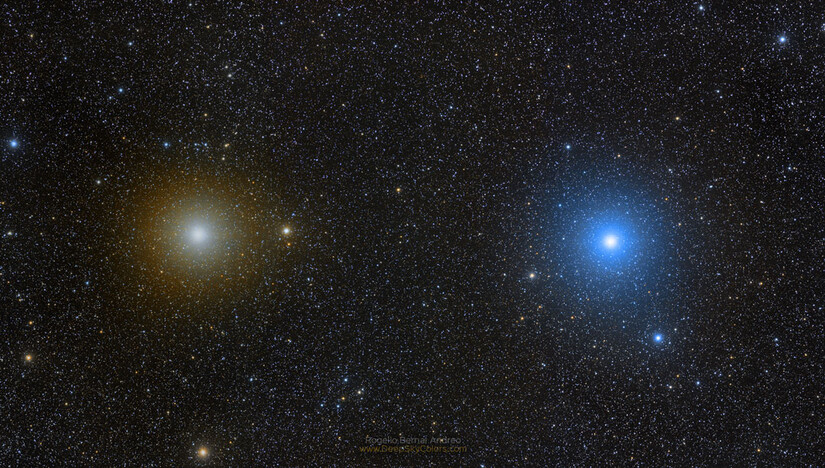 Photograph courtesy of Rogelio Bernal Andreo (Deep Sky Colors)



Sunny, with a high of 72 and low of 47 degrees. Sunny for the morning, clear in the afternoon and evening,