Image
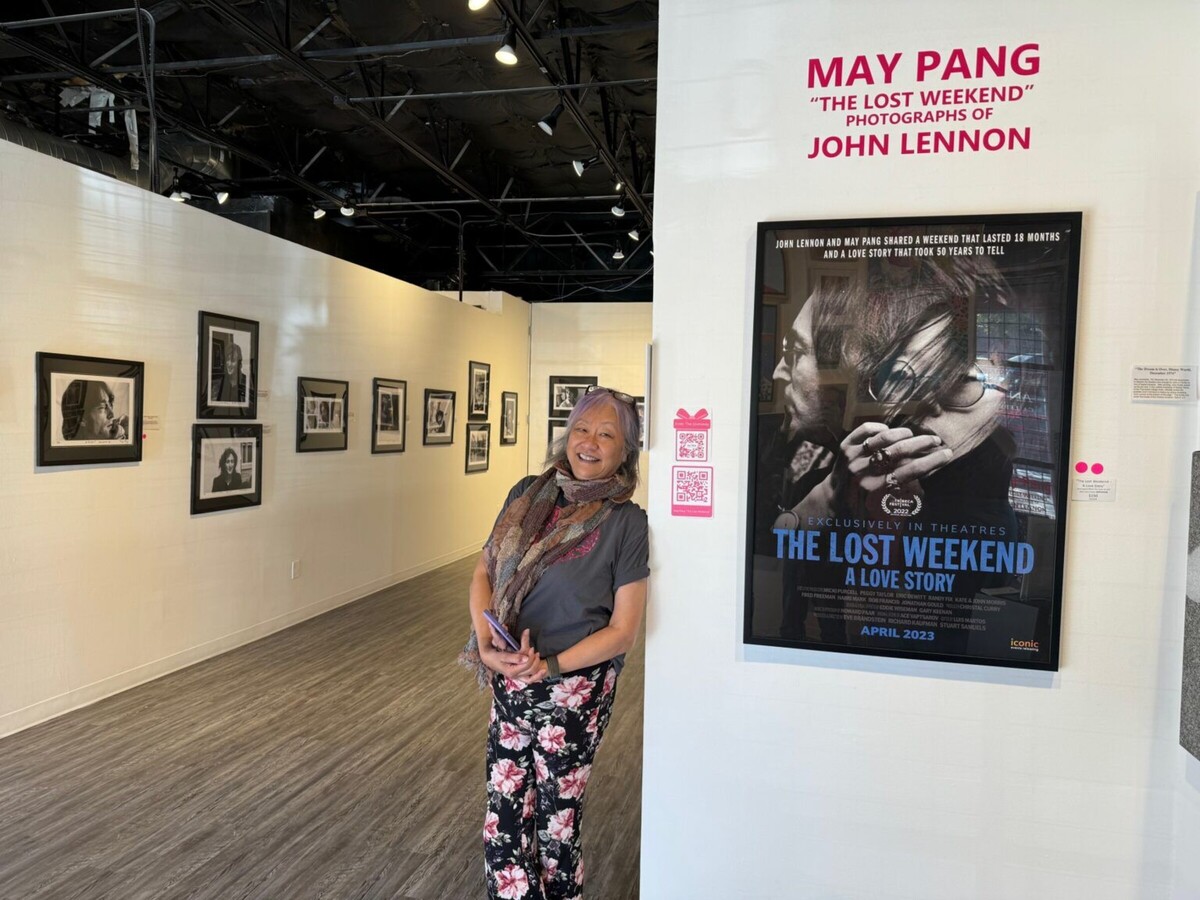
Photograph courtesy of May Pang



Correction: A previous version of this article incorrectly stated that The Lost Weekend: Photographs of John Lennon exhibit would be on display Friday and Saturday, but it will actually be open throughout the whole weekend.
There is one photograph of John Lennon that seems to capture him in a way that shows him more as just a regular man instead of the music superstar many knew him as. He is standing next to a motorcycle in the Mojave Desert, and looking happily back at his girlfriend, May Pang, as she walks up behind him with a camera and takes one shot.
That photograph is among many more that will be on display when Macon's Gallery West opens May Pang's exhibition this Friday. Pang has been touring this collection for two and a half years, logging more than 77 shows. She arrives in Macon with a story she very much wants told correctly because for decades, she says, it hasn't been.
Pang's childhood included attending a Catholic school in Spanish Harlem in the 1960s when she was growing up. An American-born daughter of Chinese immigrants, she found that she hated studying but fell completely in love with rock and roll, and above all else, the Beatles.
When a teenage Pang landed a job as a receptionist at ABKCO Records at the young age of 19, and that job quickly became serving as the full-time personal assistant to John Lennon and Yoko Ono, she found herself living something well beyond her wildest dreams. She was capable enough to help them film some of their strange avant-garde film projects, was organized, trustworthy, discreet, and she also didn't drink or do drugs.
When Lennon and Ono's marriage began to fracture around 1973, and they were arguing all the time, it was Ono who suggested to then 22 year old Pang that she might be the person best suited to date John. It was an unusual arrangement that Pang discussed in detail in her 1983 book Loving John and in her recent documentary The Lost Weekend: A Love Story on Amazon Prime.
What followed was 18 months that would shape the rest of her life. The photographs she took during that period were never meant for the public. They were made, as she puts it, for the two of them.
"You're seeing John through my eyes," she said, "The way I saw him then."
.jpg) John Lennon captured in a "Walls and Bridges" 1974 press photograph by Bob Gruen and distributed by Capitol Records
John Lennon captured in a "Walls and Bridges" 1974 press photograph by Bob Gruen and distributed by Capitol RecordsWhat she saw was a man most people never got access to: relaxed, curious, at home in the world in a way his public image rarely suggested. The motorcycle photograph from a 1973 desert road trip is a perfect example.
Lennon had spotted the motorcycle at Calico Ghost Town on the drive back from Las Vegas, and he just kept gravitating toward it. "He'd walk away, come back to it, walk away again," Pang recalled. "He didn't think anybody was watching him."
Then Pang finally called out to him, caught him off guard, and told him to just stand next to the thing.
He looked at her like she'd asked him to do something strange, then he shrugged and stood there.
She took one shot. No backup, just one photograph, with no guarantee it came out at all.
She'd never have let him ride it if he had bought it, she says.
"He wasn't a great driver!" she exclaims, but she says she wanted to let him have his moment. And then she photographed it.
Another favorite image by the photographer shows Lennon floating in the Long Island Sound, borrowed onto a neighbor's boat on a lazy afternoon, happy and sun-warmed.
"You don't see him being that relaxed," she said. "It's just unusual."
Lennon apparently appreciated her eye. "He would always say, keep taking photographs," she recalled.
The popular version of the Lost Weekend has Lennon miserable, unraveling, and drunk through most of it. Pang has been pushing back on this for years, and she's direct about it.
"We didn't have drinks in the house," she said. "He was not an alcoholic. He loved to have time with his friends - but he was like the new kid on the block, and everybody wanted to see how high he could jump."
The chaos most people associate with the period traces back largely to the notorious Phil Spector recording sessions.
"Phil was the boss, and he had ordered the drinks," Pang said. In Lennon's own sessions, back in New York, there was none of that. He was punctual, focused, and asked musicians to hold off until the work was done. "They all respected that."
She's equally pointed about the mythology around Yoko Ono's role. The story has long held that Lennon spent the Lost Weekend calling home, desperate to return. Pang says the calls went the other direction.
"She would call us not just once, not just twice - sometimes it was like 15 calls a day. John did not call. It was the other way around."
Another misconception Pang hopes to clear up revolves around where she and Lennon lived during their romance.
While many sources claimed the couple was staying in Los Angeles because of demands by Ono, Pang says that they actually ended up living in New York.
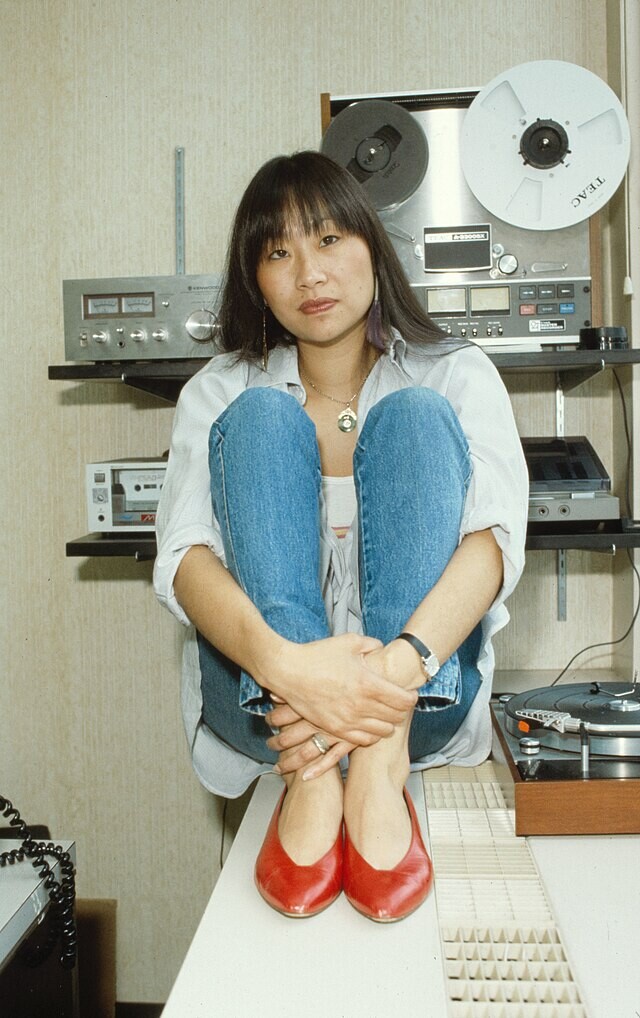 May Pang was photographed by Bernard Gotfryd in May 1983
Not everything from those years was photographed. Some moments were just too strange for that.
Pang described a hot, muggy Friday night in New York, the kind where the city empties out for the weekend and the streets go quiet. They had just come back from a recording session, and Lennon had stepped out onto the apartment balcony to smoke his French cigarettes, a smell Pang hated. She was inside waiting for a pizza delivery and only half paying attention when he called out to her.
She ignored him the first time. The second time, there was something different in his voice.
"He said now," she recalled, "and I went running."
She stepped out onto the balcony and stopped mid-sentence. Directly above their heads - close enough, she says, that Reggie Jackson could have hit it with a home run ball - was a craft unlike anything she had ever seen. Metallic, silent, ringed with white lights that pulsed on and off, with a single red light on top. Underneath it, heat waves rippled in the night air the way pavement shimmers on a summer afternoon.
"There was no sound," she said. "I could hear the highway noise, the cars honking below me. And I couldn't hear this thing directly above my head."
She started screaming. Lennon, characteristically, just stood there taking it all in. He watched it accelerate, stop, tip onto its side, then move out toward the river, tracking along buildings that were all dark on a Friday night, past the UN, down toward the water, until it finally blended into the distance and was gone.
When Lennon told people what they'd seen, the first question was always whether May had seen it too. Her reputation as the sober, clear-eyed one in the room was apparently well established.
"If someone said, do you want to do some drugs," she laughed, "I would say, can I have a steak dinner instead."
Lennon had always believed, she says. He kept UFO magazines around the apartment, ordered them regularly. Seeing the craft didn't rattle his worldview so much as settle it. "It just sort of made you go - all right. It's there," Pang recalls.
The official trailer for "The Lost Weekend: A Love Story"
The most historically significant photograph in the exhibition is one Pang almost missed entirely. She was the only non-lawyer in the room when Lennon signed the documents officially dissolving the Beatles. She was busy tending to a young Julian Lennon when John had to call out for her to come take the picture.
She shot from the front, leaning over the document, careful not to jostle the bed Lennon was using as a writing surface. The light was low. She didn't know what she had until later.
"I caught him mid-signature," she said. "Not the beginning, not the end — just right in the middle."
She flips the image when displaying it so viewers can actually read the name as he's writing it. As for the emotional weight of the moment, the legal end of the most famous band in history, she takes a longer view than most people expect.
"Everybody thinks it's sad. I think it was fine. They'd been waiting for it for so long. It didn't stop them from being friends."
Paul and Linda McCartney visited the house regularly afterward. There was even talk of a trip to New Orleans to see Paul.
The photograph John Lennon loved most of himself was taken on a September weekend in Ellenville, New York, where the two had borrowed a friend's cabin to escape the city. They were walking up a wooded trail when Pang dropped back, took in the autumn light, and just called his name.
He turned around. Pang took one shot and captured a particularly iconic image of the rock star.
Lennon was producing Nilsson's album Pussycats during some of the Lost Weekend, which meant the two of them were together in the studio regularly. Regarding her memories of Nillson, Pang laughed.
"He just wanted to have fun all the time." She continued that he was a great guy, but that he had a reputation for stirring up trouble, then walking away scot-free while someone else dealt with the consequences.
Pang made clear during our interview that Nilsson is still the legend he was, regardless of his own occasional recklessness.
"He was a brilliant, brilliant, brilliant singer and songwriter. He came up with things that were just remarkable - the lyrics, the melodies, the way he could make you feel something with his voice. When I say brilliant, I really mean it."
Pang mentioned some of the other famous people she met during her time with Lennon. She spent time around the other members of The Beatles, Ringo, George, Paul, David Bowie, and others. She even ended up in one of Bowie's music video for his song "Fashion".
Lennon later came back to spend time with her, even after the relationship had officially ended, after Yoko Ono told her she thought it was time for her to "take back John." He asked to use her photograph of him in the woods for a single sleeve release in Europe and she gave him her permission. It became known as The Walk in the Wilderness. Years later, her photograph of Julian Lennon graced the cover of his album Jude.
That Julian connection is one of the quieter and more moving threads of this whole story. Lennon's son was around ten when Pang nudged the pair toward each other, encouraging Julian to simply bring John a cup of coffee one afternoon.
"He looked at me like, what?" she laughed. The ice broke. She made sure Lennon called his son at least once a week after that. "I said, let's not do a repeat. He needs a father."
She also worked to ease the tension with Julian's mother, Cynthia. "When he called and got Cynthia on the line, there wasn't that angst that he was always having before. It just worked."
She and Julian remain in warm, occasional contact today. "He knows I care about him," she said. "I'll always be there for him."
Pang doesn't shoot celebrities anymore. Her phone these days fills up with cornfields seen from a car window, the moon over the highway, buildings whose shapes caught her eye before she fully understood why. She once photographed something she couldn't identify, but then it turned out to be a side view of the Guitar Hotel at the Hard Rock in Florida.
"We don't look at things properly that often," she said. "We just go by."
It's a small observation, but it gets at everything that makes this exhibition worth seeing. The girl from Spanish Harlem who grew up dreaming about the Beatles ended up with a front-row seat to one of the most fascinating chapters in rock and roll history - and had the instincts and the eye to document it.
May Pang went on have a successful career with United Artists Records and Island Records as a public relations manager after her time with Lennon, working on albums by artists like Bob Marley and Robert Palmer. Pang married record producer Tony Visconti in 1989, and the couple had two children before divorcing nearly 40 years later in 2001.
Pang continues to stay in touch with those she met through Lennon, including Cynthia and Julian Lennon. She was even invited to Linda McCartney's memorial service by Paul.
Pang now volunteers with Animal Haven, an animal shelter in New York, and also co-hosts "Dinner Specials with Cynthia and May Pang," an internet talk radio show with Argentine pop singer and songwriter Cynthia Nilson.
It was obvious throughout our interview that Lennon had an enormous impact on Pang's life.
While Yoko Ono is the woman most often closely associated with Lennon, he once told journalist Larry Kane that his time with Pang "may have been the happiest [he had] ever been...I loved [that] woman..." Pang obviously made a big impact on Lennon as well.
Pang says that her photography allows viewers a rare chance to see Lennon without any of the angst or posing seen in many of the photographs of him as he candidly relaxes at home in peace.
May Pang's photographic exhibition is open this weekend only at Gallery West in Macon. Pang will be present for the opening on Friday. Her documentary, The Lost Weekend: A Love Story, is currently streaming on Amazon Prime.

Sunny, with a high of 74 and low of 52 degrees. Sunny for the morning, clear for the afternoon and evening,