Image

The sunset on Friday night was spectacular (Photographer Nate Weeks)



The week's high temperatures will start out in the 80s, and then swiftly drop into the 40s on Thursday night, if the National Weather Service's forecast is accurate. Rain is forecast to arrive on Wednesday but leave well before the weekend. The following is the day-by-day weather forecast for this week in the heart of Georgia.
DAY-BY-DAY WEATHER FORECAST
MONDAY, March 9th
Partly sunny with a high temperature near 81.
Monday Night
40% chance of showers and thunderstorms before 11 p.m., then a chance of showers until 2 a.m., and then a return of showers and thunderstorms after 2 a.m. Mostly cloudy skies with a low temperature around 61.
TUESDAY, March 10th
30% chance of showers and thunderstorms, mainly before 11 a.m. Partly sunny skies with a high temperature near 83.
Tuesday Night
Partly cloudy skies, with a low temperature around 62.
WEDNESDAY, March 11th
Partly sunny skies with a high temperature near 85.
Wednesday Night
80% chance of showers, mainly after 2 a.m. Mostly cloudy skies with a low temperature around 51.
 The crowds in Downtown Perry sought shade from the hot sun while enjoying traditional dances at the 3rd annual Perry International Festival this past Saturday (Photographer Nate Weeks)
THURSDAY, March 12th
80% chance of showers, mainly before 8 a.m. High temperature near 81.
Thursday Night
Clear skies with a low temperature around 40.
FRIDAY, March 13th
Sunny skies with a high temperature near 68.
Friday Night
Clear skies, with a low temperature of around 47.
SATURDAY, March 14th
Sunny skies with a high temperature near 84.
Saturday Night
Clear skies with a low temperature around 52.
SUNDAY, March 15th
Clear skies and a high temperature of around 82. Winds South at 5 to 10 mph.
Sunday Night
Partly cloudy skies with a low temperature of around 56.
ASTRONOMY IN MIDDLE GEORGIA
This week, the Moon will appear in the celestial sphere near Antares, a bright red star, on Tuesday. Astronomers say this star is 700 times larger than the Sun. It was used by ancient navigators and had an important part in mythology. Then, on Sunday, Mars, the red planet, will appear in our night sky near Mercury, observable either with binoculars or the naked eye. Mercury is the smallest planet in our solar system. The small planet is the closest one to the sun in our solar system, so its surface temperature ranges from -290 degrees at night to 800 degrees during the day, making even our hottest summer days seem downright chilly.
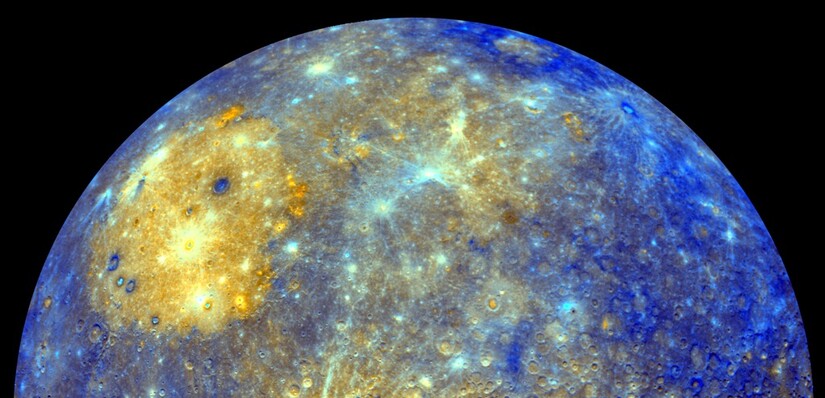 This false color image of Mercury shows show information about the distribution of different rock types, including the Caloris basin, appearing as a bright yellow circular area because of its volcanic plains (Image courtesy of NASA/Johns Hopkins University Applied Physics Laboratory/Carnegie Institution of Washington)


Sunny, with a high of 68 and low of 50 degrees. Sunny in the morning, clear in the afternoon and evening,