70° and Clear
Image

What cost is their in what some call progress? (Photograph courtesy of Photo by Ludvig Hedenborg on pexels.com)



The young man sat on the bank of a small lake in Jones County, the place he called home. It was summer, and he had made his way out to the secluded property of a friend of the family so that he could relax and fish for a few hours.
He leaned back against a tree, sun shining down dreamily, birds chirping all around him in the forest. He watched his bobber lazily float, little minnows playfully tugging at his bait, and before he realized it, sleep overtook him.
Somehow, he found himself transported five years into the future.
Before he could even open his eyes, he noticed the hum. It was as unnatural as yellow skies or green water. He felt it in his bones as much as he heard it, a low, ceaseless vibration that pressed against his chest and rattled behind his eyes.
When he opened his eyes, the songs of the birds were gone.
The silence they left behind was not quiet, but crowded, filled with that humming sound, thick and relentless. The light was wrong - instead of golden sun rays falling through the trees, gray clouds covered the sun.
The tall trees that once ringed the lake were gone. In their place stretched gravel and concrete. He closed and rubbed his eyes, then opened them again, but nothing had changed.
Before him stood vast one-story, box-like structures of steel and concrete, larger than any cluster of buildings he had ever seen.
They sprawled like a bleak industrial city, windowless and uninviting, each more immense than the last. They stood shoulder to shoulder, their weighty presence blotting out the sky.
LED lights on tall poles cast harsh shadows that made him squint and shield his eyes with his hand. Even in the dying daylight, the glow felt like a sentinel’s watchfire: unending, unwelcome.
The lake he had been fishing still existed, but the water had darkened and shrunk, its surface lifeless. The fish no longer darted or leapt; instead, the water lay dull, unresponsive to wind or ripple.
Then the smell reached him.
It was like a poorly managed mechanic’s shop - oil and transmission fluid soaked into concrete, mingled with the exhaust of diesel engines.
The air felt gritty in his lungs, as though each breath took in tiny shards of metal.
At the far corner of the bleak complex, smokestacks jutted into the sky. Smoke curled from them in thick streaks before joining the low, bruised clouds that hung like a threat.
A loud cough sounded behind him.
He jumped and turned quickly.
An older woman stood about ten feet away, bent slightly at the waist, coughing into a handkerchief. Her eyes were watery but sharp, fringed with deep lines that spoke of hard years.
“You gonna get sick if you stay out here,” she said, gesturing toward a small house behind her. “If you want to come in, I’ve got some sweet tea.”
He realized then how thirsty he was. His mouth felt dry, and his tongue was thick. He had also never turned down sweet tea in his life.
Inside, the air was cooler, but it carried a constant whirring. He could almost feel it vibrating through the floorboards.
“I run air purifiers all day long,” she said between coughs. “If I don’t, my asthma acts up something fierce. Can’t stay outside long anymore.” She studied him with weary concern. “Saw you standing there looking lost. Didn’t want you catching the cough.”
“The cough?” he asked, bewildered. This felt real, yet it could not be. Surely it was just another strange dream.
She gave a tired laugh. “Everyone’s got it now. Folks ’round here call it the data center cough. It’s that diesel they run, and you can taste it in the night air.” She paused, eyes distant. “Some days it’s worse than others.”
She poured the tea. Beneath the sugar, he tasted a bitter, metallic tang.
“What happened here?” he whispered.
She followed his gaze to the looming structures. “That,” she said, “is what they called progress. They told us it’d bring jobs, tax money, and growth. Said we needed to be part of the future. Promised it’d be quiet as a church.”
Outside, the hum seemed to grow louder, as if mocking her words.
“They came to crowded meetings at city hall,” she continued. “Showed us pretty pictures. Said it’d be good for our property taxes, good for our kids' futures. But when they built, they tore down the trees. The schools used to sit surrounded by woods: now the kids hear that hum every day, every night.”
“And when the power flickers,” she went on, “those great diesel beasts wake with a roar. Their smell hangs in the streets for hours after they go off, too.”
He felt a wave of dizziness and an ache in his chest. His heart beat fast; his head throbbed with the unceasing drone. He began to cough, dry and sharp.
She nodded, resigned. “It gets to everybody sooner or later.”
The hum rose until it filled his ears, his head, his heart. The walls seemed to tremble. He staggered back, panic rising like a hurricane in his veins.
“I don’t belong here,” he gasped. “This isn’t right.”
Her face softened. “No,” she agreed. “It isn’t. But it’s what they said we should welcome.”
She reached out and took his hand. “Tell them what you saw. Tell them about the smell and the hum and the cough. Tell them about the water that’s not the same anymore and the nights without stars. Don’t let them tell you it’s nothing. Don’t let them trade your birds and wind and clear water for promised jobs that barely last.”
The hum stretched into a long, terrible note. The air thickened around him.
Then he woke with a gasp.
He lay beneath the tree, sunlight warm on his face. The lake sparkled before him, alive with fish and insects. The many birdcalls in the air felt like music after that unsufferable hum. A breeze rustled the leaves overhead, soft and peaceful.
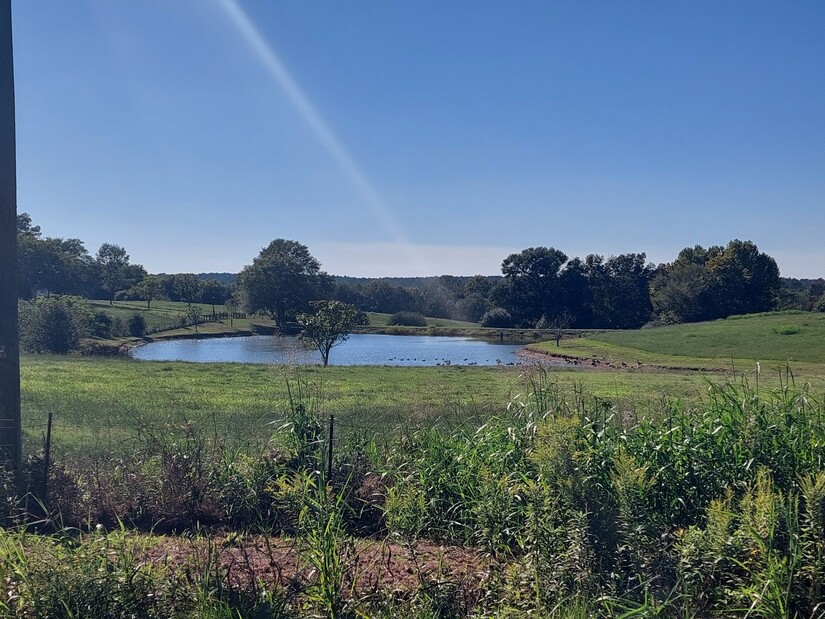 A beautiful pond located in Jones County (Photographer Nate Weeks)
He stood and looked around, committing everything to memory: the towering trees, the blue sky, the magnificent songs of unseen birds.
There were clouds, fluffy and white, drifting across the tree-filled skyline.
In the distance, beyond the woods, the sound of a revving tractor-trailer drifted on the breeze, so faint it could almost be ignored. But it reminded him of the hum he had heard, and he shivered.
He hurriedly packed up his fishing gear and began the drive home urgently, afraid he might find some other nightmarish scenario around every corner.
When he reached the first houses of Jones County, he saw the same quiet neighborhoods. Trees were everywhere, lakes sparkled in the sunshine, and neighbors were outside tending to their yards and gardens. Suddenly, he knew what he must do.
He would tell everyone he knew that the dream had revealed a glimpse at the future of what could be. He would tell them to guard what still lived and sang here, before the hum came and took it all.
He pressed down on the gas, risking a speeding ticket but knowing he must hurry before the future arrived in Middle Georgia.
For this article, I researched online to find real people and their stories about living next to data centers. This article from Business Insider was especially informative.


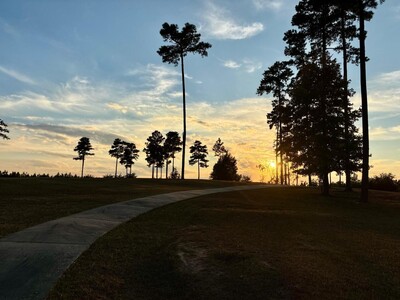
Sunny, with a high of 90 and low of 67 degrees. Sunny during the morning, clear in the afternoon and evening,