Image

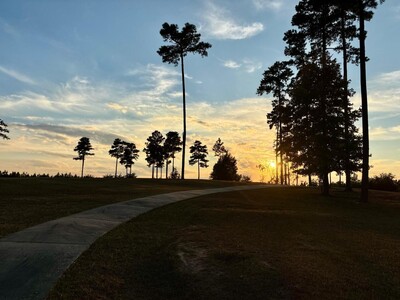
Scenic Allison Lake is located within the Piedmont National Wildlife Refuge in Jones and Jasper counties (Photographer Nate Weeks)



While last week Middle Georgians experienced warmer than usual weather, this week's temperatures should return to normal for January, according to the National Weather Service. Meanwhile, skygazers can get a good view of massive Jupiter on Saturday. The following is a day-by-day weather and astronomy forecast for this week in the heart of Georgia.
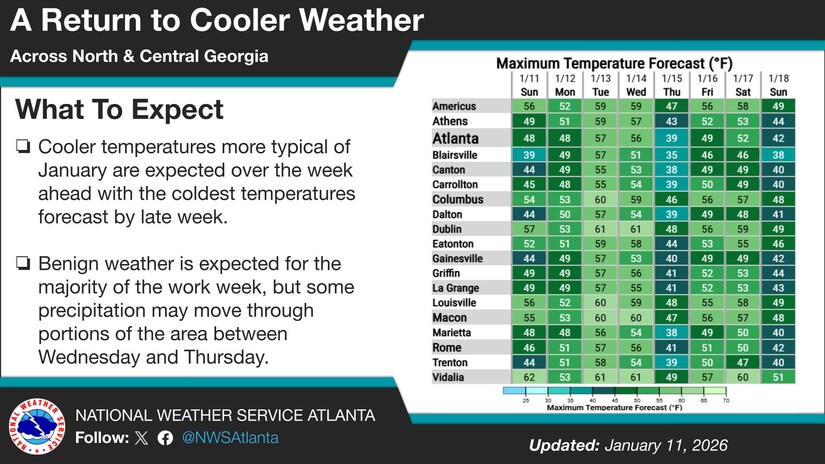 Graphic courtesy of the National Weather Service
Day-by-Day Weather Forecast
MONDAY, January 12th
Mostly sunny skies with a high temperature near 52. North wind 5 to 15 mph, with wind gusts as high as 20 mph.
Monday Night
Partly cloudy skies with a low temperature around 29 (make sure to bring in any pets and plants).
TUESDAY, January 13th
Sunny skies with a high temperature near 60.
Tuesday Night
Mostly cloudy skies with a low temperature around 38.
WEDNESDAY, January 14th
20% chance of showers. Mostly cloudy skies with a high temperature near 58.
Wednesday Night
30% chance of showers. Mostly cloudy skies with a low temperature around 32.
THURSDAY, January 15th
Mostly sunny skies with a high temperature near 46.
Thursday Night
Mostly clear skies with a low temperature around 23 (make sure to bring in any pets and plants).
FRIDAY, January 16th
Sunny skies with a high temperature near 53.
Friday Night
Mostly clear skies and a low temperature of around 31 (make sure to bring in any pets and plants).
SATURDAY, January 17th
Mostly sunny skies with a high temperature near 55.
Saturday Night
20% chance of showers. Mostly cloudy skies with a low temperature around 30 (make sure to bring in any pets and plants).
SUNDAY, January 18th
Mostly sunny skies and a high temperature around 47.
Sunday Night
Generally clear skies with a low temperature of around 29 (make sure to bring in any pets and plants).
ASTRONOMY FORECAST
SUNDAY, January 18th
New Moon and Gamma-Ursae Minorid meteor shower: When the New Moon occurs, it is basically invisible to the naked eye. This means that skywatchers can see planets, stars, and meteors that are usually not visible because of the moon's brightness. The Gamma-Ursae Minorid meteor shower will also peak on Sunday, and observers can see up to 3 meteors an hour.
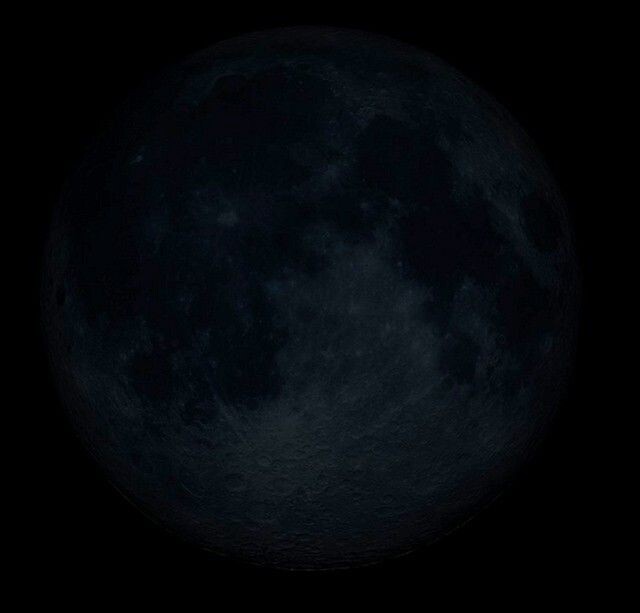 The New Moon will almost be invisible in the night sky (Photograph courtesy of NASA)


Overcast, with a high of 85 and low of 64 degrees. Overcast in the morning,